
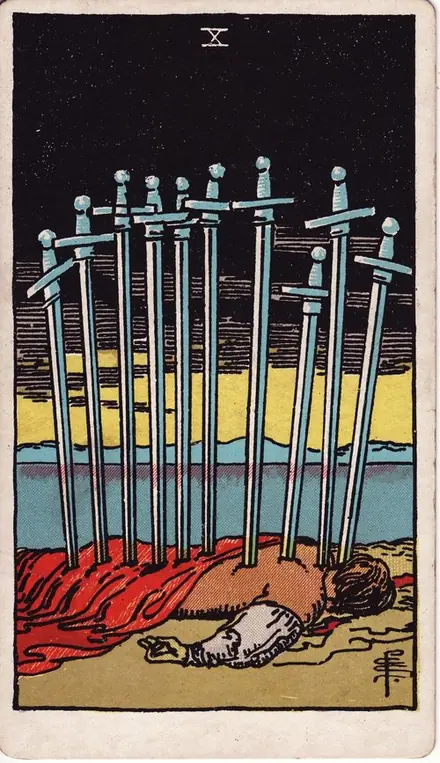
Card at a glance
- Card number
- 10 — pip card of the Suit of Swords
- Arcana
- Minor Arcana
- Suit
- Suit of Swords
- Element
- Air
- Planet
- Sun
- Zodiac
- Gemini
- Archetype
- The 10th step
- Yes / No
- No
- Keywords
- Painful endings, deep wounds, crisis
Overview
Ten of Swords is the card of painful endings, deep wounds, crisis. Its core message upright is simple: painful endings, deep wounds, crisis. Reversed, that same energy turns inward or sours into recovery, regeneration, resisting the end.
Ten of Swords belongs to the Suit of Swords, the suit of thought, communication, and truth. Minor Arcana cards describe the practical texture of daily life — the conversations, tasks, moods, and decisions that fill the space between larger turning points.
Its number carries the theme of completion, culmination, and the handover to a new cycle, filtered through the air temperament of the suit.
Astrologically the card is associated with Sun and Gemini, and it belongs to the element of Air. Those correspondences are not decoration — they tell you the tempo of the card. Air moves through words and thought; expect this card to show up as a conversation, a realisation, a document, or a decision that has to be argued out.
Read Ten of Swords as an answer to the question you actually asked. The same image means something different in a love spread than in a career spread, and the sections below break the card down across each area of life so you can take only what fits.
Ten of Swords meaning
Upright meaning
Upright, Ten of Swords means painful endings, deep wounds, crisis. This is the card working with you rather than against you: the energy is available, the timing is reasonable, and the main thing standing between you and the outcome is whether you engage.
In a practical reading, that shows up as clarity arriving through information — something said, written, or finally understood.
Keywords to hold while you read: painful endings, deep wounds, crisis. If several of those words describe your situation already, the card is confirming what you suspect rather than introducing something new.
The upright card is rarely a promise. It is a description of the current conditions and where they lead if nothing interrupts them. Treat it as a weather report you can still dress for.
Reversed meaning
Reversed, Ten of Swords points to recovery, regeneration, resisting the end. A reversal does not cancel a card — it changes its direction. The same energy is present but blocked, delayed, internalised, or overdone.
Ask three questions when this card lands reversed. Is the energy stuck (nothing is moving yet)? Is it internal (this is happening inside you rather than out in the world)? Or is it excessive (you have too much of a good thing)? One of those three usually fits, and the answer changes the advice completely.
Reversals also soften timing. Where the upright card suggests something is already in motion, the reversal usually means it is a stage earlier than you hoped — still workable, but not yet resolved.
If the reversal feels harsh, remember that the reversed reading names a problem precisely so you can act on it. Ten of Swords reversed is a diagnosis, not a verdict.
Love and relationships
In love and relationships, Ten of Swords speaks to a painful chapter ends.
If you are in a relationship, read the card as a description of the current dynamic between the two of you rather than of your partner alone. Tarot describes the space between people at least as often as it describes the people themselves.
If you are single, the card describes what you are bringing to the next connection and what pattern is currently active. That pattern is the thing to work with — it will shape whoever arrives next far more than any prediction can.
Reversed in a love reading, the same energy tends to show up as recovery, regeneration, resisting the end playing out privately: the feeling exists but has not been said aloud, or it has been said so often that it has lost its weight.
Career and work
For work, study, and vocation, Ten of Swords indicates a career chapter ends painfully.
Look at where the card sits in your spread before acting on it. In a "present" position it describes your current working conditions; in an "advice" position it is telling you what to do next; in an "outcome" position it is describing where the current approach lands you.
Career readings are the easiest place to test tarot honestly. Write down what you take from this card, give it four to six weeks, and check back. Over time you build a personal record of how Ten of Swords behaves for you specifically.
Reversed, expect the career message to slow down: a delay in a decision, feedback you have not received yet, or effort that is real but not yet visible to the people who make decisions about you.
Money and finances
Financially, Ten of Swords suggests bottom-out financially.
Tarot is not financial advice and should never replace it. What the card can do is describe your relationship to money right now — whether you are avoiding numbers, over-controlling them, spending from an emotion, or building something slowly and well.
A useful exercise with this card: name one concrete money action it points to that you could complete this week. Something checkable, like reviewing a subscription, asking about a rate, or moving a fixed amount into savings. Cards get much more useful when they end in an action.
Health and wellbeing
As a wellbeing signal, Ten of Swords draws attention to the nervous system, breathing, mental load, and stress carried in the head, neck, and shoulders.
Read this as a prompt rather than a diagnosis. Tarot cannot see inside your body, and nothing on this page substitutes for a qualified medical opinion. What a card can do is notice a pattern you have been ignoring and give you a reason to book the appointment.
Given the card's keywords — painful endings, deep wounds, crisis — the practical question is whether your current routine matches the pace this card describes. Air cards usually ask you to quiet the mental noise before making a decision.
Spiritual meaning
Spiritually, Ten of Swords carries the theme of ego death precedes rebirth.
Whatever your framework — devotional, secular, or somewhere in between — the spiritual layer of a card is really about meaning: what this experience is teaching you, and who you become on the other side of it.
Sit with the image before you read another word of interpretation. Notice what you saw first, what colour drew your eye, and what the figure in the card seems to be doing. Your immediate reaction is data, and it is usually more accurate for your situation than any general meaning written for a stranger.
Yes or no?
No
Ten of Swords reads as a no, or at least a not-like-this. That is not a punishment; the card is describing a route that costs more than it returns. Reversed, the no often softens into "not yet" — the obstacle is beginning to move.
Past, present and future positions
Past
In a past position, Ten of Swords describes an experience of painful endings, deep wounds, crisis that shaped how you approach the current question. It is finished as an event but still active as a habit.
Present
In a present position, the card is a mirror: painful endings, deep wounds, crisis is the live condition right now, whether or not you have named it yet.
Future
In a future position, Ten of Swords describes where the current trajectory leads — not a fixed fate, but the most likely outcome if nothing changes. The advice section is where you change it.
Advice from this card
- Act in the spirit of the card rather than the letter of it — painful endings, deep wounds, crisis is a posture, not a checklist.
- Say the thing plainly, in writing if you can. Ambiguity is the real problem here.
- Watch for the reversed expression — recovery, regeneration, resisting the end — as an early warning sign, and correct before it hardens.
- Pair this card with a specific action and a date. Undated intentions are how readings quietly expire.
Journal, meditation and affirmation
Journal prompts
- — Where in my life right now is painful endings already present, and where am I pretending it isn't?
- — If Ten of Swords were describing a person in my life, who would it be — and what would I want to say to them?
- — What would change this week if I fully accepted the upright message of this card: painful endings, deep wounds, crisis?
- — What does the reversed version — recovery, regeneration, resisting the end — cost me when I let it run unchecked?
Meditation
Set the card where you can see it and take five slow breaths, letting the exhale be longer than the inhale. Let your eyes rest on the image without trying to interpret it. On each inhale, silently name the card's central quality — painful endings. On each exhale, release its shadow — recovery. After five minutes, ask a single question of the card and write the first answer that arrives, unedited. Finish by writing one clear sentence — the truest one you can manage.
Affirmation
“I welcome painful endings without forcing it, and I trust myself to act on what Ten of Swords is showing me.”
Related cards
Frequently asked questions
Keep exploring
- All 78 tarot card meaningsBrowse the complete Rider–Waite–Smith library with search and suit filters.
- Tarot spreads explainedSee which spread places Ten of Swords in the most useful position.
- Quick meanings cheat sheetUpright and reversed keywords for the whole deck on one page.
- Mulank numerology calculatorPair this card's archetype with your Personal Year and Month numbers.
Try a free AI tarot reading
Pull Ten of Swords in a real spread and get a personalised interpretation for your own question — no signup, no card details, in under a minute.
Start your free reading